Image: Mercury
Kaizer Chiefs have turned to a familiar face in the hope of ending years of inconsistency.
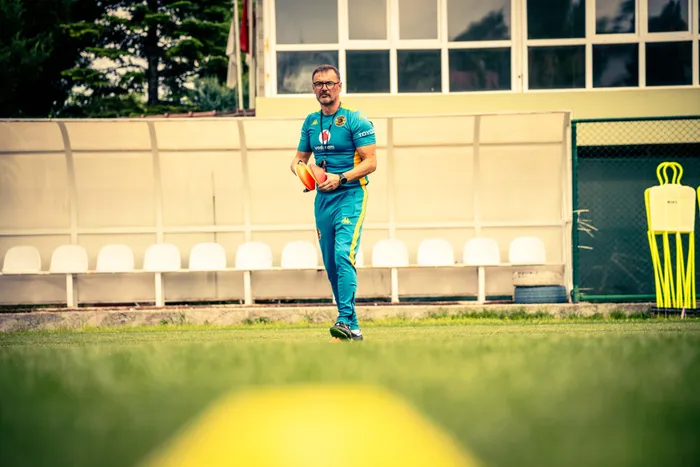
Fernando da Cruz officially began his tenure as Amakhosi head coach this week, returning to Naturena two years after a brief stint at the club was cut short by an opportunity with the Moroccan Football Federation.
His appointment offers Chiefs something they have lacked for years: continuity.
Yet it also raises an important question.
Will building on the work already done provide the stability needed to challenge for major honours, or will sticking too closely to the previous blueprint simply expose the same weaknesses that prevented the club from mounting a genuine title challenge?
The answer may define Chiefs’ 2026/27 campaign.
A familiar face returns
Unlike many new coaches who require weeks to settle into unfamiliar surroundings, Da Cruz walked back into a club he already knows.
The smiles exchanged with sporting director Kaizer Motaung Junior during his introduction reflected that comfort.
“I would like to introduce coach Fernando. Normally I would say welcome, but this is ‘welcome home, coach.’ You are coming back,” Motaung Junior told the squad.
“There are only a few faces that you may have seen from afar. Welcome coach. The boys have been working hard with the staff, and as you can see, the energy has been incredibly good today.”
That familiarity extends beyond the players.
Da Cruz has assembled a technical team comprising Mahmoud Abbas as first assistant, Dillon Sheppard as second assistant, Olivier Sorin as goalkeeper coach and Julien Le Heran overseeing sports science and conditioning.
Sheppard’s continued presence provides valuable local knowledge while ensuring continuity between successive coaching regimes.
Building on existing foundations
Perhaps the biggest advantage Da Cruz inherits is that he will not be introducing an entirely new football philosophy.
The Frenchman was originally expected to work alongside Nasreddine Nabi before departing early in his first spell, while Khalil Ben Youssef and Cedric Kaze subsequently carried much of that tactical identity forward.
That means Da Cruz arrives to continue a project rather than rebuild one.
Chiefs’ defensive improvement last season provides the clearest evidence that solid foundations already exist.
Amakhosi conceded just 19 league goals—the third-best defensive record in the Betway Premiership—transforming what had previously been one of the team’s biggest weaknesses.
Goalkeeper Brandon Petersen earned widespread praise for his performances, although the defensive organisation in front of him also played a significant role.
The departure of promising defender Aden McCarthy could have disrupted that progress.
Instead, Chiefs moved quickly to recruit Bafana Bafana international Thabo Maloisane, whose composure, leadership and positional awareness should help maintain defensive stability.
Reasons for optimism
There are encouraging signs elsewhere across the squad.
Midfielder Lebohang Maboe showed glimpses of his quality after arriving last season and was unfortunate to miss out on Hugo Broos’ final Bafana Bafana World Cup squad.
A full pre-season under Da Cruz should improve his sharpness and strengthen partnerships in midfield.
Further forward, striker Flavio Da Silva enjoyed an encouraging debut campaign.
His return of 10 goals and one assist in 31 appearances suggests there is significantly more to come once he develops greater understanding with those around him.
If Da Silva can become more clinical and Chiefs improve their creativity in the final third, Amakhosi could possess the attacking threat needed to complement their defensive resilience.
The youth dilemma remains
Despite those positives, Da Cruz also inherits one of the biggest talking points from last season.
Chiefs invested heavily in developing young talent, yet many of those prospects struggled for opportunities.
Mduduzi Shabalala remained a regular fixture, but Wandile Duba featured only sporadically despite consistently impressing whenever called upon.
Fan favourite Mfundo Vilakazi endured an even more frustrating campaign, with supporters repeatedly questioning his lack of game time during the second half of the season.
The concern is whether Da Cruz, under immediate pressure to win trophies, will trust youth or favour experience.
The challenge has become even more complicated following player departures and expected new arrivals.
With Aden McCarthy, Happy Mashiane and Tashreeq Morris all leaving the club, while further signings are anticipated, balancing squad harmony with player development will require careful management.
Pressure starts immediately
There will be little grace period for Da Cruz.
Chiefs are expected to improve on last season’s third-place league finish, challenge seriously for domestic silverware and erase memories of their disappointing CAF Confederation Cup group-stage exit.
Supporters have grown impatient after years of underachievement.
Continuity may offer short-term stability, but results will ultimately determine whether Da Cruz’s appointment is judged a success.
His greatest challenge may not be implementing new ideas.
Instead, it could be finding the courage to improve the blueprint he has inherited while avoiding the tactical stagnation that has repeatedly left Chiefs one step short of returning to the summit of South African football.
If he strikes that balance, Amakhosi may finally have found the coach capable of restoring their status among the country’s elite.
If not, familiarity alone will not be enough to satisfy one of Africa’s biggest football clubs.
Source: www.iol.co.za